


How to estimate the volume of your move in m³, and get it right
Read →Leaving the easy pace of Nice for another region is a major life change, and a move of several hundred kilometres to orchestrate. Well prepared, it goes without a hitch; improvised, it turns into a nightmare. Here is the complete step-by-step guide to a successful long-distance move: countdown plan, choice of package, sorting, packing, paperwork, moving day at both ends and settling in.
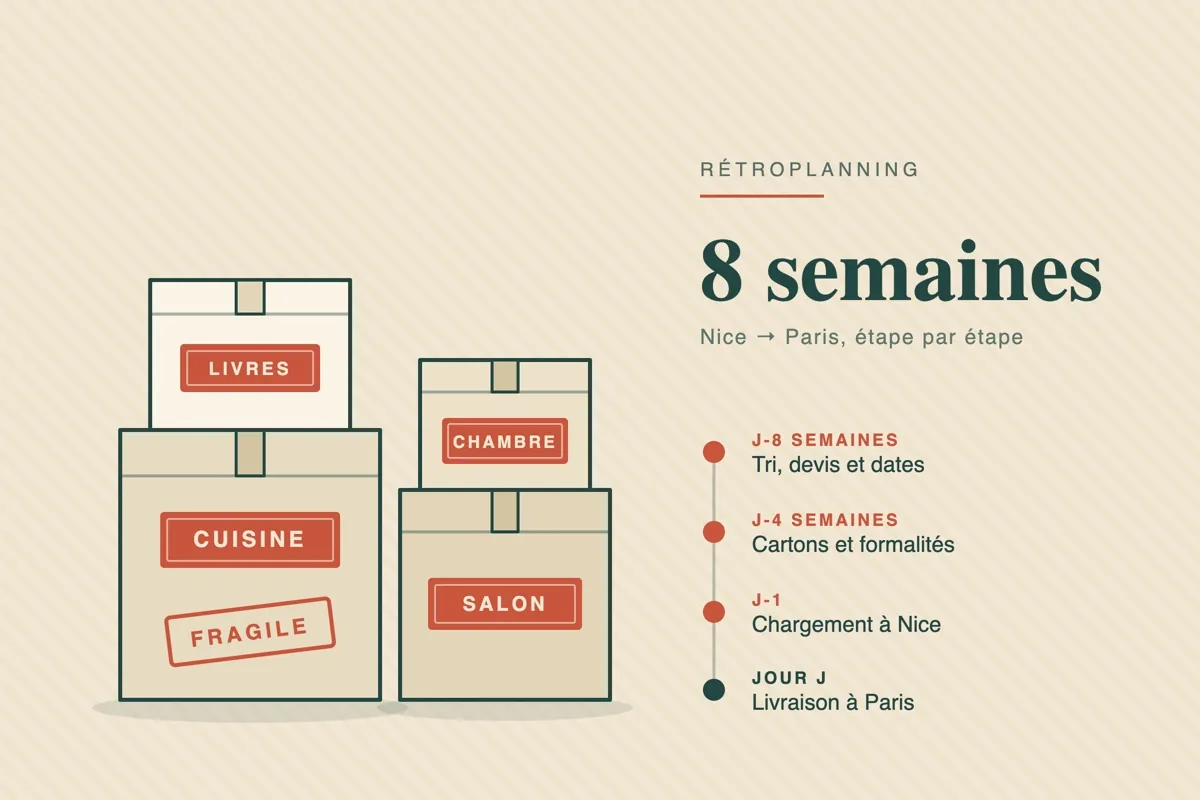
The countdown, week by week
A successful long-distance move comes down to preparation. Here is the ideal timetable:
- 8 weeks before: request your quotes and secure the date. The best slots go quickly, especially between June and September.
- 6 weeks before: sort, give away, sell. Every m³ less brings the bill down on a long journey.
- 5 weeks before: order your boxes and supplies (tape, bubble wrap, marker pens), and start with the rooms you use least.
- 4 weeks before: cancel or transfer your contracts (energy, internet, insurance) and start your change of address.
- 3 weeks before: pack gradually, room by room, labelling as you go.
- 2 weeks before: book the parking permits at both departure and arrival, and confirm access with your removal company.
- 3 days before: finish the last boxes, prepare the “first night” box, empty and defrost the fridge.
- Moving day: keep your documents, keys, chargers and first-night essentials with you.
Choosing the right package for a long-distance move
On a journey this long, the choice of package changes everything, for your comfort as much as for your budget:
- Standard: you pack your boxes, we handle the heavy lifting, the transport and the unloading. The most economical option, ideal for smaller budgets and studios.
- Premium: we protect your furniture, pack the fragile items, dismantle and reassemble. The right balance for a calm move without wearing yourself out.
- Luxe: we take care of everything, from packing the last plate to reassembly on arrival. For busy diaries and precious possessions.
The full details and a comparison are on our packages page.
Sort and lighten the load before a journey of several hundred kilometres
This is the step that pays off most. Over a long distance, paying to transport things you no longer use is money wasted. Sort by category: what you keep, what you sell (furniture in good condition, appliances), what you give away (charities, online platforms) and what you throw away or recycle (the household recycling centre for bulky items). Tired flat-pack furniture does not travel well: it is often wiser to replace it on arrival than to transport it.
The art of packing: boxes that survive the journey
Over several hundred kilometres, packing everything snugly is crucial: a badly filled box gets crushed, and poorly protected furniture gets scratched. A few rules of the trade:
- Books and heavy items in small boxes, so that they can still be carried.
- Crockery wrapped piece by piece in paper, stood upright and packed tightly.
- Clothes in wardrobe boxes or suitcases, to save time.
- Screens and electronics in their original boxes if possible, otherwise well protected and marked “fragile”.
- Label every box with the room it is going to and note its contents: it will transform the unloading at the other end.
With our Luxe package, the team packs everything for you, using professional materials; with Premium, it packs your fragile items.
On a long journey, the quality of the loading matters as much as the driving. Over several hundred kilometres, nothing must move inside the van.
Dismantling, reassembly and furniture protection
Bulky furniture travels better dismantled: wardrobes, beds, large tables. Keep the screws and fittings in labelled bags, taped to the matching piece of furniture. Each piece is then protected with blankets, covers and film, and secured in the van so that it cannot move on the motorway. On arrival, we reassemble everything. With a full-service package, this dismantling and reassembly is included: you will not need to get out a screwdriver or an instruction leaflet.
The paperwork when you change region
A long-distance move also comes with administrative paperwork that should not be overlooked:
- Energy and internet: cancel or transfer, and sign up at your new address so that you have power and a connection straight away.
- Address: update your details with the tax office, your bank, insurers, employer, social security and top-up health insurer; change the address on your vehicle registration certificate within one month.
- Post: set up a redirection service so that nothing goes astray during the transition.
- Children: enrol them at their new school, allowing for the time the process takes.
- Parking: the all-important parking permit, at both departure and arrival.
Departure day
We load early, to avoid the summer heat and the seafront traffic. The team protects the last pieces of furniture, carries the boxes out by the stairs, the lift or a furniture lift, depending on the access, and secures everything in the van. Keep a “survival suitcase” and your important documents with you: they do not travel in the van. Depending on your neighbourhood, the parking space will have been reserved in advance (see Nice, neighbourhood by neighbourhood).
On the road
A day of driving separates the two cities. In a dedicated van, your belongings never stop off in a warehouse and are never transferred to another vehicle: they travel directly, in the care of the same team, towards an arrival window confirmed in advance.
Arrival day
On arrival, we unload during the reserved parking slot, carry everything up by the stairs, the lift or a furniture lift depending on the building, reassemble the dismantled furniture and set everything up room by room. With a dedicated team from departure to arrival, the same removers handle your move from the first box to the last: no transfers between vehicles and no dilution of responsibility.
Settling in, and the “first night” box
Keep a “first night” box within easy reach and clearly marked: sheets, pillows, wash bag, chargers, coffee maker, some cutlery, toilet roll, a lamp. It is the little secret that turns what could be an exhausting first evening into a simple matter of moving in. Unpack the kitchen and bedrooms first; the living room and decorative items can wait until the weekend.
Mistakes to avoid
- Packing everything the day before: start several weeks ahead, room by room.
- Overloading large boxes: they become impossible to carry and split open.
- Not labelling: on arrival, you end up hunting for things in thirty identical boxes.
- Forgetting the change-of-address formalities: weeks of lost post and wasted paperwork.
- Leaving the “first night” box at the back of the van: keep it with you.
Frequently asked questions
How many boxes do you need for an apartment?
Allow roughly 15 to 20 boxes for a studio, 25 to 35 for a one-bedroom apartment and 40 to 60 for a two-bedroom apartment. It is better to have a few extra.
Do furniture and drawers need to be emptied?
Yes, furniture is moved empty: it is safer for the furniture and easier to carry. Clothes can stay in some lighter chests of drawers; check with the team.
For the figures, lead times and logistics, read our Nice to Paris removals page. And when you are ready, request your free quote within 24 hours: we will be with you from the first box to the last shelf.